
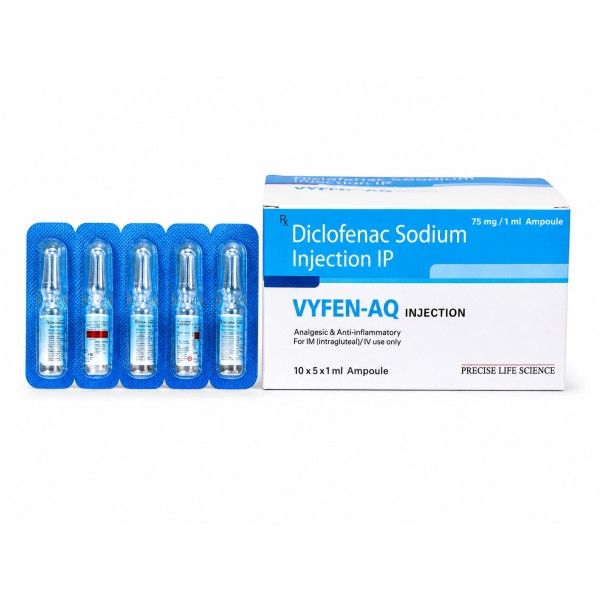
VYFEN-AQ Injection
- Manufacturer: Precise Life Science
- Category: Injectables
- Pack Size: 10*5*1 ml
- Availability: 56
Product Details
VYFEN-AQ Injection
Generic Name: Diclofenac Sodium Injection IP
Strength: 75 mg/1 mL
Dosage Form: Injection (IM/IV)
Pharmacological Class: Non-Steroidal Anti-Inflammatory Drug (NSAID)
Product Description
VYFEN-AQ Injection contains Diclofenac Sodium 75 mg/1 mL, a potent NSAID with analgesic, anti-inflammatory, and antipyretic properties. It is indicated for the short-term management of moderate to severe acute pain and inflammatory conditions when oral therapy is not feasible or rapid pain relief is required.
It is intended for administration by healthcare professionals through deep intramuscular (IM) injection or slow intravenous (IV) infusion, according to prescribing guidelines.
Composition
Each 1 mL ampoule contains:
- Diclofenac Sodium IP – 75 mg
- Sterile aqueous vehicle – q.s.
Mechanism of Action (MOA)
Diclofenac works by:
- Inhibiting Cyclooxygenase (COX-1 and COX-2) enzymes.
- Reducing the synthesis of prostaglandins, which are responsible for pain, inflammation, and fever.
- Decreasing inflammation at the site of tissue injury.
- Providing rapid pain relief and improved mobility.
Indications / Uses
VYFEN-AQ Injection is used for the short-term treatment of:
Orthopedic Conditions
- Acute musculoskeletal pain
- Low back pain
- Sprains and strains
- Tendon injuries
- Sports injuries
Post-operative Pain
- General surgery
- Orthopedic surgery
- Dental surgery
- ENT procedures
Renal & Biliary Colic
- Kidney stone pain
- Gallstone pain
Rheumatic Disorders
- Rheumatoid arthritis
- Osteoarthritis
- Ankylosing spondylitis
- Acute gout attacks
Gynecological Pain
- Severe dysmenorrhea
- Post-operative gynecological pain
Trauma
- Fractures
- Soft tissue injuries
Advantages
- Rapid onset of pain relief
- Powerful anti-inflammatory action
- Helps improve mobility
- Reduces swelling and stiffness
- Suitable when oral medication cannot be taken
- Proven NSAID with extensive clinical use
Dosage
Adults
- 75 mg IM once daily.
- May be repeated after several hours if required.
- Maximum dose: 150 mg/day.
Duration should generally not exceed 2 days. Patients should be switched to oral or rectal diclofenac as soon as appropriate.
Administration
Intramuscular (IM)
- Administer by deep intragluteal injection.
- Alternate buttocks if repeated injections are required.
Intravenous (IV)
- Should be diluted and administered as a slow IV infusion.
- Do not administer as a rapid IV bolus.
Administration should be performed only by trained healthcare professionals.
Side Effects
Common
- Injection site pain
- Nausea
- Vomiting
- Indigestion
- Heartburn
- Dizziness
- Headache
Less Common
- Diarrhea
- Constipation
- Skin rash
- Edema (swelling)
- Elevated liver enzymes
Serious
- Gastrointestinal ulcer or bleeding
- Severe allergic reactions (anaphylaxis)
- Bronchospasm (especially in aspirin-sensitive asthma)
- Kidney impairment
- Liver dysfunction
- Cardiovascular events (heart attack or stroke with prolonged/high-dose use)
Seek immediate medical attention if severe allergic symptoms, black stools, vomiting blood, chest pain, or difficulty breathing occur.
Contraindications
Do not use in patients with:
- Hypersensitivity to diclofenac or other NSAIDs
- Active peptic ulcer or gastrointestinal bleeding
- Severe heart failure
- Severe liver disease
- Severe kidney impairment
- Aspirin-induced asthma
- During the third trimester of pregnancy
- History of NSAID-related allergic reactions
Precautions
Use with caution in patients with:
- Hypertension
- Heart disease
- Kidney disease
- Liver disease
- Elderly patients
- History of gastric ulcers
- Asthma
- Bleeding disorders
Monitoring
- Blood pressure
- Kidney function
- Liver function
- Signs of gastrointestinal bleeding
Avoid prolonged use without medical supervision.
Drug Interactions
Use cautiously with:
- Anticoagulants (Warfarin)
- Antiplatelet agents (Aspirin, Clopidogrel)
- Other NSAIDs
- Corticosteroids
- ACE inhibitors
- ARBs
- Diuretics
- Lithium
- Methotrexate
- Cyclosporine
- Tacrolimus
Use in Special Populations
Pregnancy
Avoid during the third trimester. Use earlier in pregnancy only if clearly prescribed.
Breastfeeding
Small amounts pass into breast milk. Use only on medical advice.
Pediatrics
Not routinely recommended unless specifically prescribed.
Elderly
Higher risk of gastrointestinal bleeding and kidney-related adverse effects. Use the lowest effective dose.
Storage
- Store below 25°C.
- Protect from light.
- Do not freeze.
- Keep out of reach of children.